Conserving Water Resources
June 2026 is exceptionally hot and dry. Several consecutive days with temperatures reaching 35–40 degrees have resulted in the longest and most intense heat wave ever recorded in June. Please be sure to use water sparingly—we’ve got some valuable tips for you.
High Demand for Water – Peak Consumption Reached
The SWK’s water traffic light provides early information on the status of the drinking water supply. Currently, the water traffic light is on yellow. Although the lack of rainfall in April, May, and especially June doesn’t become noticeable until two to three months later due to a time lag, However, the extreme heat on June 25, 2026, in Kaiserslautern resulted in the highest annual peak water consumption to date, at approximately 30,000 m³. This peak consumption roughly represents the limit for a stable water supply to the city.
It is reasonable to assume that consumption will decline moderately during the school holidays. Experience from previous years shows that water consumption typically drops by about 10% when the holidays begin, as some residents of Lautern are away on vacation. However, the ongoing heat wave is expected to lead to further spikes in consumption, which is why SWK is asking residents to use drinking water sparingly.
You can find the current status of the water traffic light at any time here on the blog or at link.swk-kl.de/wasserampel
Conserving water is a must
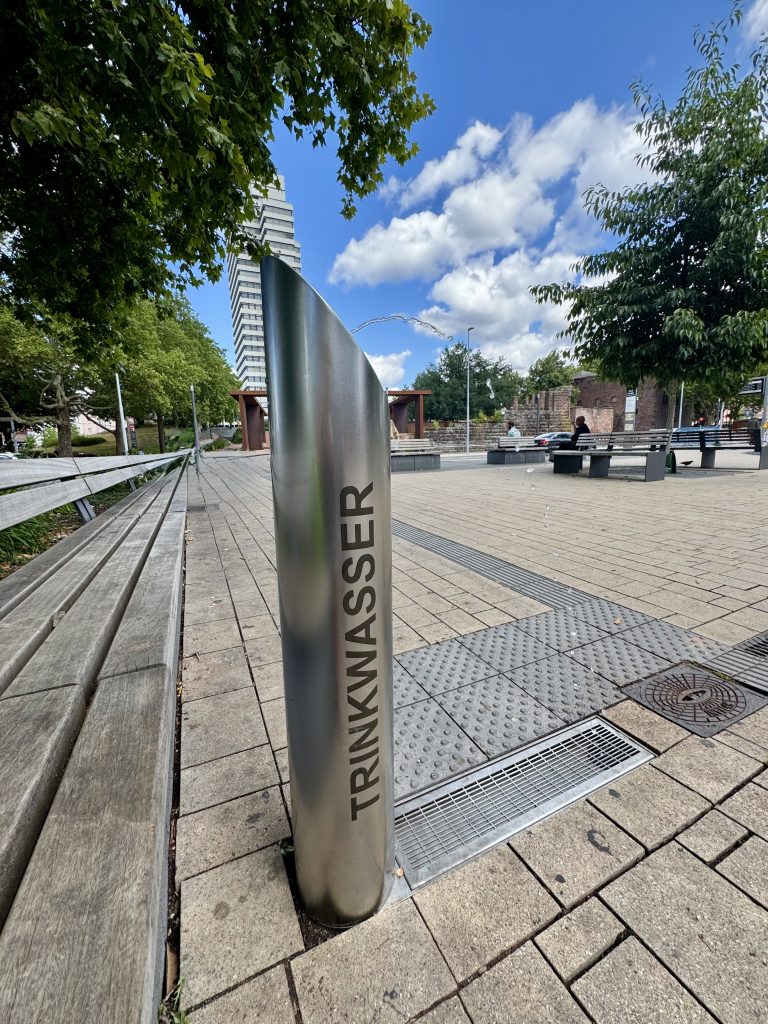
Hot summers like this one and general climate change pose a major challenge to our water supply.
We’re used to having clean drinking water coming out of our taps at all times. This summer is showing us early on—and in no uncertain terms—what it means when water reserves are running low: dry plants in gardens, rivers with low water levels, and forest and wildfires are constant topics in the news.
To ensure a reliable water supply over the long term, we must all use one of our most important resources—drinking water—sparingly.
Important Tips for Saving Water
- Use the energy-saving cycles on washing machines and dishwashers as often as possible, even if they take longer.
- Don’t wash vegetables and lettuce under running water; wash them in a bowl instead. You can then use the dirty water to water your plants.
- Water the plants in your garden in the morning, preferably before sunrise, or in the evening after sunset, to reduce water evaporation.
- It’s better to use garden hoses placed close to the plants (e.g., drip irrigation) rather than sprinklers. In general, you should consider whether it’s really necessary to water your lawn.
- Don’t mow the lawn too short, and mow it less often: A longer lawn retains moisture better.
- Collect rainwater to water your garden.
- When planting, look for drought-tolerant plants with lower water requirements.
- Replace dripping faucets immediately. If a faucet drips once every two seconds, approximately 800 liters of water go to waste down the drain each year.
- Take advantage of classic money-saving tips, such as not letting the water run while brushing your teeth, always filling the washing machine and dishwasher to capacity, taking showers instead of baths, and so on. Filling a bathtub requires about 170 liters of water, while a five-minute shower uses only about 70 liters.
Modern faucets and toilet tanks help save water and energy
- Upgrading to a water-saving toilet tank reduces the flush volume to 6 liters, instead of 9–12 liters. With the water-saving technology of a modern toilet tank, you can save up to 10,000 liters of drinking water per year (Source: ASEW)
- Single-handle faucets are generally more economical than two-handle faucets. With a single-handle faucet, you can adjust the desired water flow and temperature using a single handle.
- Water-saving fixtures in the kitchen, toilet, and bathroom can reduce water consumption by up to 50%.
More and more backyard pools are leading to increased water consumption
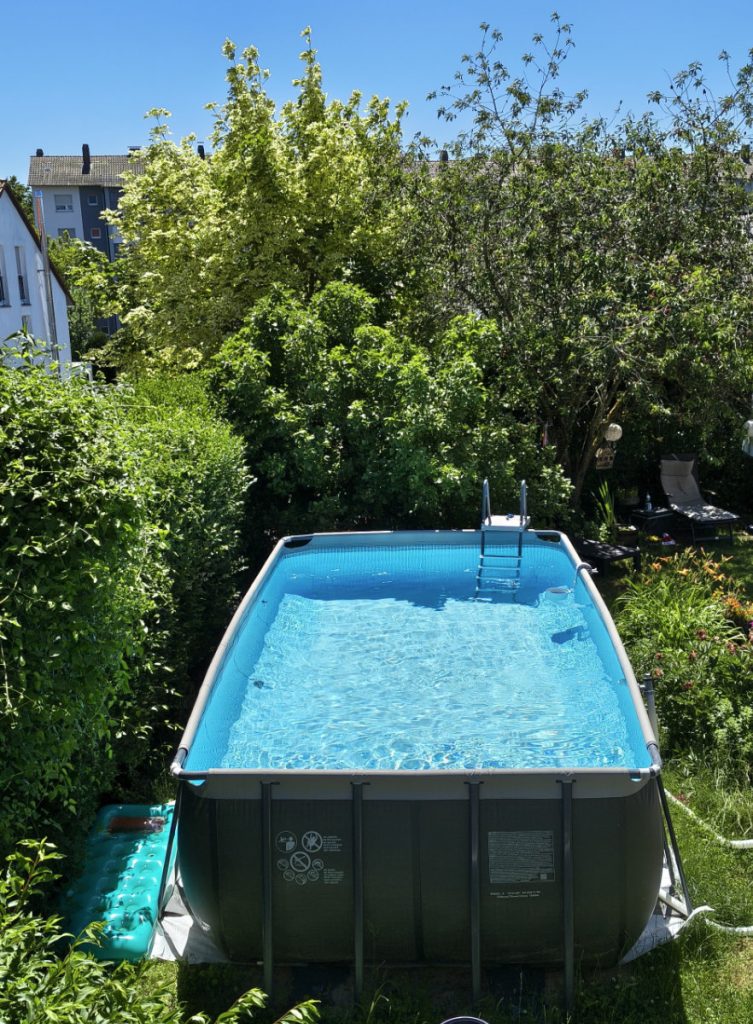
Whether it’s an in-ground pool or an above-ground pool—the popularity of backyard pools is on the rise. However, this also poses challenges for the water supply and massively increases water consumption in the summer: An average above-ground pool with a diameter of 3.60 meters has a volume of 6,500 liters. This is equivalent to 52 times a person’s daily water needs.
To reduce the strain on the water supply system, avoid filling the pool on hot days during peak usage times in the morning or early evening. Also, fill the pool only after sunset and cover it whenever possible. This reduces evaporation.
Please note that you should not fill any pools when the water traffic light is yellow or red.
Together for the region - please support us!
Please use water wisely. Even when the water light is green, you can make a valuable contribution to ensuring a reliable water supply in our region.
We will keep you informed about the status of the water traffic light system through a variety of channels, especially when the traffic light phases change. On the SWK blog, we provide ongoing updates on the current situation. You can also find information on our social media channels and, if applicable, in the daily press or on the radio.
Thank you very much for your help!
You might also be interested in

Advisor, Energy and water, Energy future
Regular remote monitoring of your solar or wind power system
To prevent the power grid from becoming overloaded, grid operators must be able to control solar and wind power plants…
Advisor, Energy and water, The region and us
The water traffic light is green. Please continue to use water sparingly.
SWK’s water traffic light provides early information on the status of the drinking water supply. It has been back to…